
"What is a token?"
We were walking a pilot firm through our pricing when the senior partner across the table stopped us with the simplest question we had heard in months: "What is a token?"
One of us reached for an analogy. A token is like fuel: you've bought the car, but the work burns fuel as you drive, and the fuel is what you pay for. The partner listened carefully. "Okay, I am getting it," he said, and he said it kindly, the way senior people say it when the explanation has failed and they have decided not to embarrass anyone. Everyone in the room could feel it. The metaphor was forced, and forced is how it landed.
For a while we told ourselves the usual vendor story: the model is new, the market needs education, he'll get used to it. Then we stopped, because that story blames the one person in the room who had done nothing wrong.
The confusion was ours
Look at who was sitting across from us. A man who has priced complex legal work for decades. Who quotes to the page, files within page limits, fights disputes over records measured in thousands of pages. Who reviews invoices line by line, because checking numbers against work is part of what his profession is. There was nothing about pricing he needed taught.
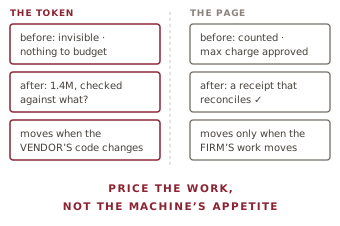
What we had asked him to do was buy a unit from our world instead of his. A token is an engineering measure. It is invisible before you spend it, so nothing about a matter tells you what it will cost. It is unexplainable after you spend it, so there is nothing for the firm's accounts team to check an invoice against. And it moves with how our machinery happens to work that week, not with how much work his firm actually asked for. We had taken the most careful buyers in the world and handed them a number they could neither predict nor verify, then wondered why the conversation felt stuck.
A confused customer does not argue with you. He nods politely, and then he does not buy. And if he does buy, the confusion follows him into the product: every time he starts a job, a small anxious question runs in the back of his mind. How much of this am I using? Am I overspending? Will the invoice surprise me? People do not do their best work with a taxi meter they cannot see ticking somewhere behind them. The confusion was not his failure to adapt to us. It was our failure to translate for him, and it was quietly poisoning both the sale and the product.
Their unit was there all along
Once we framed it that way, the whiteboard session was short. Every profession keeps a native unit for work. Law settled on its unit generations ago: the page. Court records run to pages. Filings are limited in pages. Fees, bundles, exhibits, printing, review: pages, pages, pages. A litigator can look at a matter and feel its size in pages, the way we feel ours in engineering measures.
We didn't need to educate the market about our unit. We needed to adopt theirs.
So PRAMAAN's pricing became one sentence, in the customer's own language:
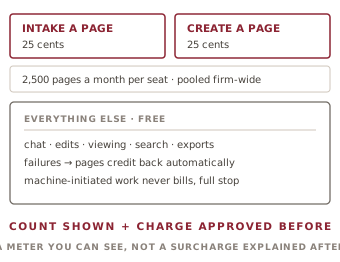
Intake a page. Create a page. The meter only ever speaks in pages.
When the firm brings a page of the record into PRAMAAN's intelligence, that is intake, and that page counts. When counsel commands a new document into existence, its pages count. And to say the quiet part plainly: counsel's own reading is free. Once a page is in, counsel can open it, search it, cite it, question it and study it for as long as the matter runs, without the meter existing at all. Asking PRAMAAN to go back and read a document again is a different thing from reading it yourself — it is work the firm asked for, so it is counted, and it is counted in pages like everything else.
The free list is where the worry gets removed, and it is deliberately long. Typing to the assistant: free, unlimited. Edits to the draft in front of you: free, and so is keeping them — autosave and saving the version you are working on cost nothing. Viewing, searching, exporting: free. The meter moves again only when counsel explicitly asks PRAMAAN to generate a new version of a document. That is commanding a new document into existence, so it is a new create, priced on every page of the newly rendered version — save version one and pay nothing; ask for a fresh 22-page version two and, once the page count is approved up front, that is 22 create pages. The meter only ever speaks in pages. If a job fails, its pages come back automatically; nobody pays for our bad day. And anything the machine does on its own initiative is our cost, never the firm's. The bill moves only when a human at the firm asks for work, which means a lawyer can finally hold the entire pricing model in their head while they use the product, and then stop thinking about it. That, not the number, is the point.
Removing the meter from their heads
Two mechanics finish the job, and both exist to take the anxiety away rather than to be clever.
Before any billable work runs, the firm sees the page count and approves the maximum charge. Pricing happens before the work, in daylight, never as an archaeology exercise on the invoice. And the page counts themselves come from receipts we treat as contractual, so when the bill arrives, every line reconciles to something the firm can inspect. A partner who audits us should find the exercise boring. Boring is what trust looks like on an invoice.
There is a cost on our side, and it is fair to name it. Pages shift the volatility to us: our cost of taking in a difficult, scanned, handwritten page is higher than a clean one, and the customer's price doesn't move. We carry that difference deliberately. We are the ones equipped to manage machine costs; asking a law firm to absorb the variance of our machinery was the original mistake, just wearing a different hat.
What the partner actually taught us
The lesson we took from that meeting was never really about pricing. We are a company of engineers, and left to ourselves we will describe everything, honestly and precisely, in our own units. But we don't build for ourselves. The people we serve have a language, older than ours, in which they are exact and confident and fast, and every time we make them translate into ours, we hand them confusion and call it their homework.
So the rule we wrote down afterwards applies to much more than the price list: we may think like engineers, but we must speak like lawyers. The partner with the fuel question never needed to learn what a token is. He needed us to notice that he had been telling us the right unit all along, every time he picked up a brief and weighed it in his hand.
The full rate card, in your region: pramaan.io/pricing.