The second attack
Suppose the proof holds. Every claim in your filing is grounded, every source traceable, and the other side knows it. A capable opponent does not concede at that point. They move the attack one level down: from what your record says, to how your record was made.
Watch the scene properly. Eight months into an arbitration over a terminated supply contract. A procedural hearing, a wood-panelled room, three arbitrators, the transcript running. Your chronology has been doing quiet damage all year: it puts the other side's termination notice two full weeks after the cure period expired, and in eight months they have not been able to shake a single entry.
Their senior counsel rises, ostensibly on a scheduling application. On the way past, almost as a courtesy, he adds one thing. "We note, for the record, that the claimant's chronology has been through a number of revisions. In due course we may ask when its entries took their present form. The tribunal will understand our interest in whether that timeline was assembled from the record, or for it." And he returns, pleasantly, to the calendar.
Be clear about what he just implied, because it is easy to miss how concrete it is. He is not suggesting a typo. He is suggesting that one entry, the load-bearing one, was moved after your side understood what the case needed it to say:
| Entry | Event | Your chronology today | What he implies it once said |
|---|---|---|---|
| 41 | Defect notice served | 6 May | 6 May |
| 42 | Defects cured | 5 June | 26 June |
| 43 | Termination notice received | 19 June | 19 June |
Read row 42 both ways. If the defects were cured on 5 June, the termination that arrived on 19 June tore up a contract that had already been fixed: wrongful, and your whole claim stands on it. If they were cured on 26 June, the termination was justified and your case is gone. One row, three weeks, the entire dispute. That is why a chronology gets "revised," and why the mere suggestion of it is worth a sentence of any opposing counsel's time.
Nothing was alleged, so there is nothing to object to and nothing yet to rebut. But watch the room. The presiding arbitrator's pen, which had been resting, writes one line. Your client's general counsel, beside you, writes a longer one and underlines it. The insinuation has been seated at the table, and it will attend every hearing from now on, sitting quietly behind every entry your timeline puts up.
The suggestion cost them one sentence, delivered in under a minute, and notice the worst part: it did not need to be true. Now count what it costs you.
Doubt is cheap; reconstruction is expensive
To answer, you must reconstruct the history of your own work: who accepted that timeline entry, on what day, from what review, and whether anything touched it since. In most practices that history lives nowhere in particular, and everyone in the profession knows the two rooms where the search goes to die.
The first is the version soup. A shared drive holds chronology_final.docx, chronology_final_v3.docx, and chronology_final_v3(2)_AR_edits.docx, each carrying a different date, none knowing which of them the partner actually reviewed. The file that would settle the question exists eleven times, which is the same as not existing at all.
The second is worse: the person. The associate who accepted that entry left the firm last spring. Their inbox is archived somewhere, their recollection is now a phone call to someone else's employee, and the other side knows that a witness who must say "as far as I remember" has already half-lost. Institutional memory that lives in people walks out the door with them.
So the reconstruction becomes an associate's lost week: taping the history back together from mail threads, drive timestamps, and goodwill. Days or weeks, at hourly rates, under a deadline. And while you reconstruct, the doubt sits in the room doing exactly what it was designed to do.

This is the same asymmetry that buries proof under volume, aimed at a new target. Flooding the record makes truth expensive to find; questioning your process makes truth expensive to defend. The opponent doesn't have to show your record was altered. They only have to make "prove it wasn't" cost more than you can afford before the clock runs out.
Why "we keep logs" fails
The instinctive answer is the one every software vendor gives: the system keeps logs. It fails here, for a reason lawyers see faster than engineers do.
A log written by the accused is not an alibi. If the people who operate the system could have edited its history, then the history proves nothing; the mere possibility of tampering is all the doubt needs. And ordinary logs fail in quieter ways too. They record what machines did, in machine language, not what counsel decided, in the language of the matter. They cover the paths someone remembered to record. They age out, get trimmed, get "cleaned up." An account with gaps, written in the wrong language, editable by its keeper: that is not memory. That is material for the other side's next suggestion.
The requirement, stated plainly, is stranger and stricter: the matter must remember itself, and its memory must be beyond the reach of everyone who might ever benefit from changing it. Including the firm. Including us.
Memory without an eraser
In PRAMAAN, the matter's memory is not a report generated on request. It is part of the matter's substance, written the same way grounded claims are welded to their sources.
Every action that touches the matter becomes a permanent entry: the exhibit uploaded, the timeline entry accepted, the review granted, the risk expressly taken. Each entry carries who acted, what they did, and when, in the vocabulary of the matter, not of the machinery. And the entries obey three rules that give the memory its evidentiary weight:
- It is written without an eraser. No entry can be edited or deleted once it exists. Not by the associate, not by the partner, not by the firm, not by PRAMAAN. The system was built with no mechanism for rewriting its past, which is a different and stronger statement than a promise not to use one.
- The action and its memory happen together. An action that fails to leave its entry does not happen at all; the two are a single event. There is no window, however small, where work occurred but the record of it didn't.
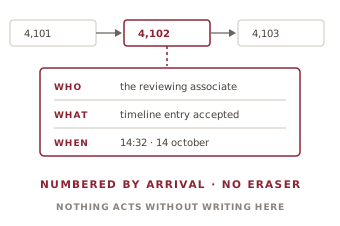
- Order is beyond argument. Entries are numbered by arrival, one after another, so "which came first" is a fact the matter can state, never a debate between clocks and recollections.
When the actor is software
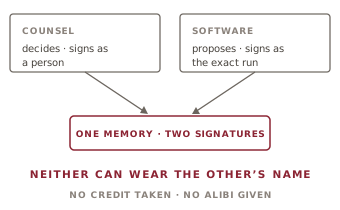
One more rule matters more every year. Some of the hands touching a matter now belong to software: an assistant proposes a timeline, drafts a summary, flags a contradiction. In the matter's memory, software signs as software, every machine action tied to the exact run that performed it, reviewable end to end.
Picture the scenario that is coming for every firm that adopts these tools. The assistant proposes forty timeline entries from the record; your associate reviews them and accepts thirty-eight. A year later, one of the thirty-eight is challenged: did a lawyer actually look at this, or did the machine write your chronology? Without the distinction in the memory itself, there are only two bad answers. With it, the entry reads plainly: proposed by the software, from these pages of the record, on this run; reviewed and accepted by the associate, that afternoon. The machine's suggestion and the lawyer's judgment, each signed for what it is.
The rule cuts both ways, and both directions protect counsel. A machine's work can never wear a person's name, so no lawyer is ever on record for a judgment they didn't make. And a person can never hide behind the machine, so "the AI must have done it" is never available as an alibi, to anyone. Counsel decides; the software proposes and gates; the memory keeps the two forever distinct.
The one-line answer
Return to the hearing, and to the suggestion floating in the room.
Your side does not ask for a recess to investigate. You read from the matter itself: memory entry 4,102, chronology entry 42, defects cured, 5 June, accepted by the reviewing associate at 14:32 on the fourteenth of October from the chronology review, welded to the completion certificate it came from; and no entry has touched it since. The account is complete because nothing can act without writing to it, ordered beyond argument, and unalterable by anyone with a stake in it, which the other side's own expert can verify.
The suggestion was engineered to cost you weeks. It cost you one line.
That is what memory means inside a computable matter. The claims are welded to their sources so proof can survive an attack on the record. The actions are welded to their history so the work can survive an attack on the process. A matter that remembers what happened, in order, forever, in a voice no one can ventriloquize, doesn't just answer entry 4,102's question. It makes the question not worth asking.